Establishing Traffic Enforcement Funding


Allocation Criteria and Ranking


in Tennessee

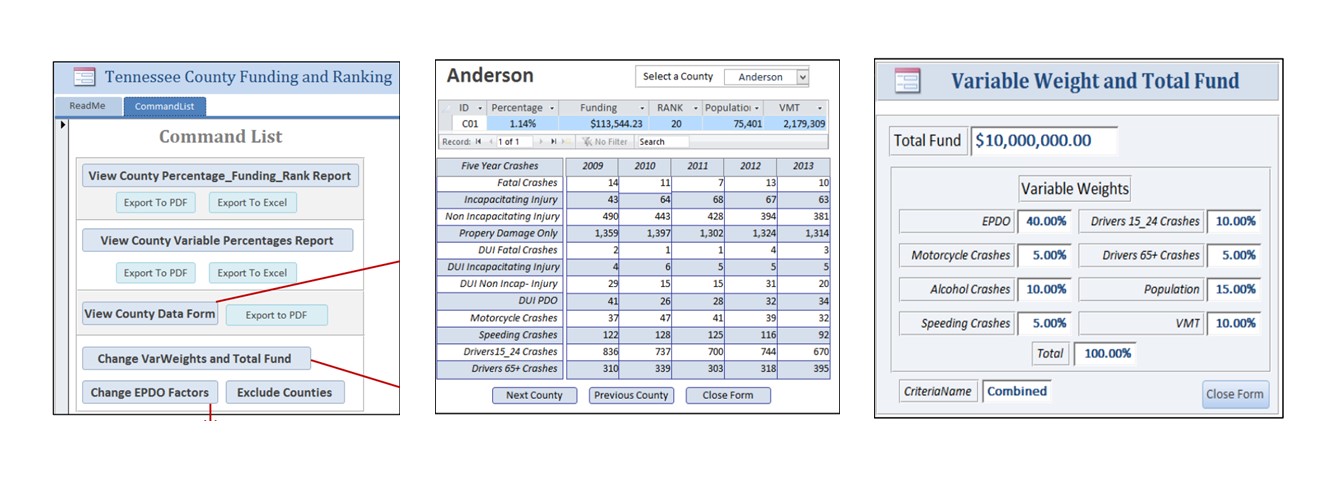
State agencies such as Tennessee Governor’s Highway Safety Office (GHSO) work with the National Highway Traffic Safety Administration to implement traffic safety enforcement programs focusing on occupant protection, impaired driving, speed enforcement, truck and school bus safety, pedestrian and bicycle safety. The objectives of this research were to develop the traffic enforcement ranking and funding criteria as well as a tool that take into account several variables in allocating annual grant for traffic enforcement. The variables that were considered include county crashes (Equivalent Property Damage Only, injury severities, alcohol related, speeding related and motorcycle related), population, vehicle miles of travel (VMT), and the crashes involving young and senior drivers. The developed tool was based on Microsoft ACCESS database with the capability of generating reports in PDF or Excel files
Developing Decision Support Tools to


Assess Bicycle and Pedestrian Safety

The main objective of this research project was to develop decision support tools to assess pedestrian and bicycle safety in Tennessee. The goal of the tool was to improve the understanding of the causes of pedestrian and bicycle crashes and identifying appropriate operating strategies to enhance pedestrian and bicycle safety. Research outcomes;

  • Conducted cluster analysis in GIS and identified high crash locations within the spectra of socioeconomic and demographics.
  • Developed Safety peformance functions (SPFs) and examined relationships between bicycle/pedestrian crashes and the associated factors.
  • Developed criteria for high crash location identification and a framework to prioritize funding of bicycle and pedestrian safety improvemnets.

  • Guidance for Site Selection, Safety


    Effectiveness Evaluation, and Crash


    Modification Factors of Median Cable


    Barriers in Tennessee

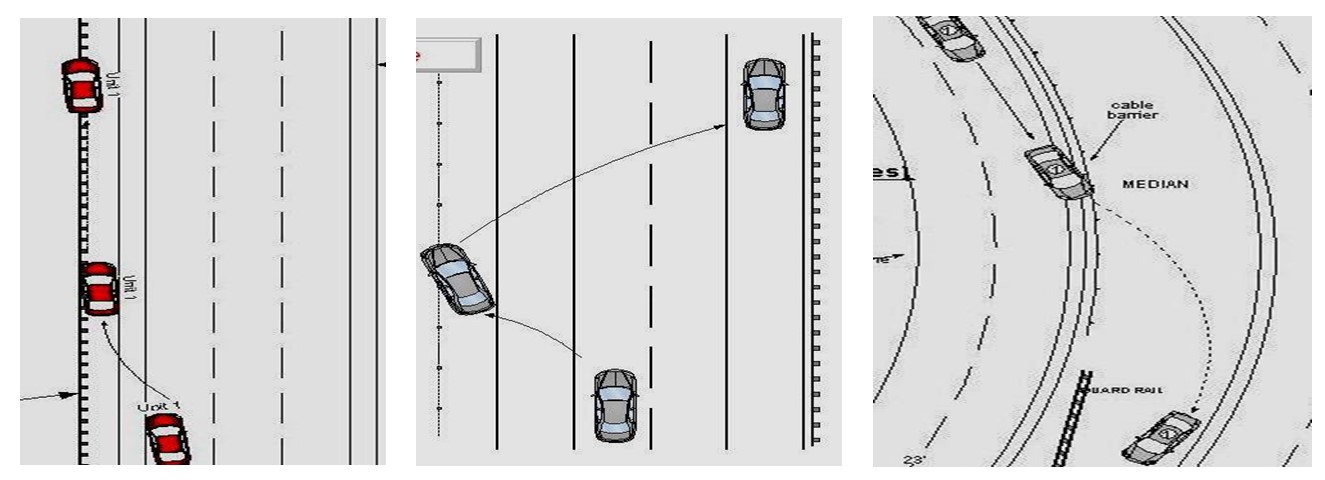
    Median Cable Barrier Systems (MCBS) have being installed along some highway segments across the state of Tennessee since 2006. The main objective of installing this system is to prevent cross-median crashes, which usually tend to be more severe than other type of crashes because they mostly involve head-on crashes with vehicles traveling in the opposite direction. The primary objective of this study was to evaluate the effectiveness of MCBS in reducing cross-median crashes. More specifically, the safety effectiveness evaluation procedures outlined in the 2010 HSM were used in the analysis.